Sunday, November 28, 2010

Metacognition: A Tribute to Aristotle

This Black Friday, I declared that I needed some new clothes along with some new furniture, hence went to Woodfield Mall at 4 am and purchased some shirts and a couple of pants for dirt cheap. However, my favorite furniture store in the world was not having a Black Friday sale, which was quite disappointing. The moment I walked into IKEA, there was very little of what I'd expected. Low prices were scarce and discounts were applied to only the products that I didn't need. Overall my expectations were debilitated, although I purchased the table and bookshelf that I needed.

Returning home, while having loose Swedish furniture pelt my shoulders due to the construction on my street, I carried my new furniture and clothes up to my room only to find how filthy my room was. My eyelids jumped in shock, as I started to pick up my clothes and place my books aside to have them placed on the new bookshelf. Sadly, I was far from building my furniture for I had to transform my sea of papers into a neat stack. As I did so, I took the time to observe the papers laying on the floor and the miscellaneous wrappers as well. I regretfully reminisced to the day before when I had made this mess to find my insurance forms.

As time poured into the drain, the infinite quantum of sheets and wrappers allowed me to run across a few memories. The guitar tabulates of Stairway to Heaven reminded me when my friend Allen and I attempted to master the song. The A- final essay I wrote Freshman year reminded me how proud I was in that moment. I also found a Snickers wrapper when a few of my buddies and I slept over and snuck out to 7-11 to get it. After holding it for a few seconds, I realized how nasty it was that it was preserved with a bunch of papers and threw it away immediately. Copious stacks were made, excluding the wrappers, and every single one was stacked in categories of School, Music, and Artwork. I kept imagining my earlier years and how I wanted to go back in time to endure the bliss of my achievements, and failures weirdly. I then imagined how it'd be like reminiscing at an older age, which began to sadden me. Then my thoughts expanded into thinking how I would think back in college or when I'm married. In an instance, I omitted these thoughts after seeing that an hour had passed and it was time to assemble the furniture. After cleaning up the mess I'd made, I felt terrific, just as if I'd finished my homework. In other words, I was heavily alleviated to know my room was sort of clean and now my mom won't nag at me anymore.

Now, going to the clothes and furniture. The clothes I hang in my closet in an instance. All you have to know about the furniture is that I cut myself on the corner of a shelf and I had developed a callus on the side of my finger, due to the cheap Allen wrench IKEA had provided me with to screw in the bolts.

As I slowly placed the stacks of paper onto the new table and bookshelves, I came back to reminiscing about my memories and how precious they are. These are some of the things that will  matter to you more than anyone else, and taking the time to look back on all these things, I realized I had a legacy to leave behind. The more I make to myself, the more I can reminisce and learn from my achievements and failures.

After that, I went to bed.

Therefore, The papers I stacked are organized so I can go back to it whenever I can, and I believe that's the way our memories should be, like an IKEA warehouse, which by the way is a horrible metaphor and so I apologize.

Images' origin - http://photos.orblogs.com/photos/2007/07/Ikea-Warehouse.jpg

Thursday, November 18, 2010

Carry It Forward: Sophie's Understanding

As discussed in class, our universe is yet to be discovered for there is bound to be greater finding. For all we know, the universe is expanding, changing in ways that we can only guess what it would be like. For all we know, we can be part of another galaxy, or one of the many universes currently present in space. There are indeed theories such as the "M Theory," or multi-verse, in which there are other universes in different dimensions, but we can only be so sure. And so to this day, we can only try to assume there is something out there, past our Andromeda galaxy and past our solar system. The thing is that the studies we are undergoing are becoming much more complex, meaning more questions to whether or not it can be or should be. However, the question is should it aught to be?

Baltasar Gracian, a Spanish philosopher, once said that the studies of our world and our being is questionable in many ways, so copious in fact that he resorted to simplifying his mind. Gracian spent most of his life studying the things around us, and he envisioned it to be so complex, he came to the realization there is no happiness in trying to answer your own questions. Throughout his life, Gracian wrote manuals criticizing other philosophers and politicians, such as Machiavelli, to try and create an ideal image of what he believed to be reasonable (e.g - qualities which make the sophisticated man of the world). Gracian was able to do so by disobeying his superiors, or by questioning religion itself, like many such as Martin Luther. Ironically, what Gracian then did in his old age was resort back to religion. Although this may seem like an unorthodox thing to do, he realized there is no need in trying to transcend our knowledge all at once. Thus, he simplified his mind and began to reflect on what he had discovered in his early years to recur his findings.

The message I'm trying to convey is not to give up on thinking because you might think it's too complex. I mention Gracian because he was one of the many philosophers of his time (The Baroque) and even now who attempted to transcend the common thinker to see the flaws and try to cope with new ideas to allow it to flow better. Of course all ideas cannot be as immaculate as the skies blue, but Gracian took the time to observe and recreate. Gracian happened to resort to religion due to his own beliefs, the message I'm trying to convey is if we look at things both ways, then it will give us a wider, broader perspective on what goes on on our planet. There are obviously questions that will be brought up to mind and restrict your ideas, definitely, but isn't it better to have them in mind? After all, Plato, Aristotle, Gracian, Locke, and many other philosophers contributed ideas that acted as stepping stones into our modern day world. Many times, philosophers questions one another to try and expand their thinking to fill in the gaps of others' ideas.

There's the old saying diversity is good, look how America turned out. Ideas start as thoughts and those thoughts, if achieved to some degree, become theories. Within the process in which the idea becomes a theory, it must undergo agreement, in other words a sort of universal balance; a sort of intervention. In my belief, i truly advocate conflicting arguments to a topic if the contributions are fair and reasonable. Therefore, diversifying ones' ideas may lead to something greater and expand its territories, kind of like how we view the universe.

Taken from the Humanities homepage

Friday, November 12, 2010

Best of Week: Maya Lin Documentary

Maya Lin is an amazing artist who dedicated her time and ideas into monuments that would preserve history. She did so by tinkering with every detail of her work; improving it and adding a greater meaning into her art. One of the ways she was able to add meaning was the connections she had made in her marble sculptures, such as the one she has in Alabama. The marble circle she had made simply told the story of what many African Americans faced and the events that changed the lives of many. She made it simple and clear to the visitors and added a spark of light into as well. She added water to show how everything flowed, and she did so by making sure the flow was even and altered everything to make it near perfect.

I believe that Maya Lin has allowed for viewers of her works of art to capture the perspective of what she was thinking to add a greater meaning. She did it really well with her marble sculpture and I believe that's what art should be like, simple and pristine.

Friday, November 5, 2010

Best of Today: Athens

In class, we were given a question on why Alberto taught Sophie about Athens, and then given a quiz. Sophie was given a video with Alberto in Athens and then they go back in time to meet up with Socrates and Plato. When Sophie was asked by Plato the question about how all cookies were baked to be exactly alike. However, Sophie questioned Plato by question the question itself. It was evident that not all cookies were the same and some were baked more bitter than the others.

Socrates was a man of wisdom and one of the most amazing people of his time. Socrates understood reasoning with others was a logical thing to do, however some believed he would use this reasoning to overthrow the government and the state as well. His ideas were therefore subversive to many. Because his ideas were so different and radical, many saw his ideas as a threat of lesser value. It's quite ironic because of the fact that Athens was a center of learning, where philosophers from other colonies came to spread ideas and learn.

Many philosophers and intellectuals in the past have perceived Socrates as a noble whose thoughts transcended the norms. Sadly in his own time, it was perceived very wrongly and rejected. In the novel, Alberto explains to Sophie that it is the nature of the philosopher to question the thoughts and actions of his contemporaries and to challenge the status quo, then they will always face persecution. Hence criticisms and the act of omitting ideas.

Going back to the cookies, although Sophie believed that not all cookies were the same, she comes to realize that its' purpose is the exactly, if not almost, the same as another cookie. Here with Socrates we find how his different idea was not considered the same because his ideas reflected upon questioning the government and the state, However, the purpose of the idea is as similar as another one. Ideas are meant to be expanded and editted, however people saw the cover of the book itself rather than what's inside it.

Monday, November 1, 2010

iMedia: A Blue Future

Going back to the late 90s, or the pre-millenium era, I found one song that I always enjoyed so much as a child, and that song is Blue (Da Ba Dee) by Eiffel 65. When it first came out, the song became an instant hit with its simple lyrics, simple beats, and its loose repetition, that for some particular reason seemed to intrigue the general audience at the time, and even today.

When the video first launched, the band, Eiffel 65, is supposedly outer space fighting aliens and flying around somewhere within the confines of the universe. This to me reminds me of Space Odyssey 2001, where humans existed in space with complex machineries and the ability to wander around the galaxy. This is obviously science fiction, and this is how we portrayed the future, a Jetson-ian kind; with flying cars and robots. When the band was creating their music video, they tried to recreate the future, with blue aliens and the ability to travel around space. However, when I look out the window, I see vehicles with four wheels and computers that are a bit more well refined. We're getting close, but not quite. The truth is, we try to uncover our future because time walks right pass you and you don't even notice it. Most of us wonder what life's gonna be, and the music video portrays an assumption based on what we envision the future to be. However, the futures not only about flying cars, nano technology, and Eco-friendliness, it's about how things change with what we had or have now.

Now Blue (Da Ba Dee), it's a popular song and it's kinda old too, so what does it have to do with anything with our modern society? If it doesn't ring a bell, pop music today has a lot of repetition, and sometimes not making any sense at all. Now before I attack pop music, I'd like to say that it's impacted the public with its easy to follow lyrics and fun to dance to beats. In fact, we had music like this in the 80s too. Even in the 60s with The Trashmen's "The Bird is the Word." The reason this kind of music has impacted the public is because in my opinion, it doesn't require a lot of focus on the lyrics but the rhythms and the beats. Music today has become more complex with more complex beats and rhythms aided by complex synthesizers and such, but it follows the same roots as Blue (Da Ba Dee). Music changes as the earth spins.

So Blue (Da Ba Dee)'s lyrics don't seem to mean anything, but some of the songs on the radio or out on iTunes today have no meaning whatsoever. I can probably name 10 songs that epitomize what I'm saying. Now if you're wondering where I got the audacity to pour my biased opinion, it comes from listening to the radio. I find myself in my car listening to B96 or KISS FM and most of the time I don't bother listening to the lyrics because I can barely decipher them and just follow along with the rhythms instead. However, when the radio plays the same songs every 4 hours at a time, it gets sickening after a while. Now I'm not saying the music today is all that horrible, I truly believe there are some good artists who enclose a fair amount of effort into their music. The sad part is when you go to a Homecoming dance or some sort of party at some kid's house, the music we're going to listen to is sadly going to be the one's that are on B96. This is our generation. Pop music means popular, and just because it's supposedly popular doesn't have to give off a lot of meaning whatsoever. We start from the 60s and 80s where repetition becomes a song, and now songs that are demeaning to woman and talks about partying until you drop and etc. Is that really what we want the pop culture to think and be influenced by? Well at this state we can only predict so much. But look on the bright side, at least these artists are making a living. And so to conclude, regardless of whether pop culture will be maintained or not, I believe pop music nowadays is just rubbish, and from the looks of it, it's only influencing itself. And as the great Andy Warhol once said, "Isn’t life a series of images that change as they repeat themselves?"

Image's origin - http://www.genetologisch-onderzoek.nl/wp-content/image_upload/andy-warhol-marilyn.jpg

Monday, October 25, 2010

Best of Week: Born Into Brothels

What seemed to a documentary of the prostitutes that live in the Red Light District turned out to be a film about hope. Hope, that of the children of the prostitutes, is conveyed throughout this film as the children are proved an opportunity to learn and gaining that knowledge out of what they've learned to progress forwards. Zana Briski has captured the beauty of knowledge, for it is one of the most powerful and compelling things that a person can gain.

Although these children and their families impecunious, I truly believe education is one of the most beautiful things one person can give to another because to me, it portrays the meaning of how humanity can nurture those who are less fortunate. Briski truly believed these children could achieve higher beyond their beliefs, and with that insight, she teaches these children about the basics of photography. As shown in the film, they pick up photography very well, and some of them are later exhibited in art galleries. The only valid reason someone would want to educate someone else is because they care, and Briski did what she did with these children because she envisioned the hope of leaving the brothels and building brighter futures.

Briski, after seeing the life that revolves around prostitution, is concerned for these children and she does almost everything she has in her power to get these children what they need. She tries admitting them into schools, traveling abroad to show them foreign lands, and teaching them everything she can about photography so these children can carry it on into the future. It touches me that so many people are victims of prostitution, human trafficking, and of abuse, and that someone like Briski would that the time to lighten up the lives of these children of prostitutes. I truly believe this is how humanity should be like sometimes.

Countless times I see people get into accidents, and the traffic behind it just steer their way through it. It's sad how only a very little percent of people would get out and aid the ailing driver to at least help one another in this microscopic world we live in. I would gladly do so, and if someone does help that person who's in the accident, others will. Sadly, that's not the case for many. It's either because they're busy and don't want to bother helping, or they'd seem like the only person that would. Whatever the reason is, this is what our humanity has come to.

As a conclusion to watching Born Into Brothels and more closely observing our humanity, it made me more aware of what goes around in this world, who tries to help and who takes advantage of what the consensus thinks. I think it's safe to say after watching the film, I am inspired to help those who are in need and to care about the people who live on this rotating sphere, known as earth.

Image's origin - http://www.generalpatton.org/images/when_humanity_fails.jpg

Wednesday, October 20, 2010

Metacognition: QE Essay

What are the obstacles to creativity, and how can they be overcome? Well, let's start off with this question. Before you question why I put the question I used in my QE Essay as the first sentence of my blog, this question is special to me. I struggled with it, questioned it, lived with it, and many times wanted to omit it. However, it was my decision to pick it hence followed through with it. I came to discover what this question was saying to me; to answer more than a question but to be its answer. It's weird that I say this but to actually answer the question, I found myself in a position where I had to explore the depth of the question, besides observing the word order in the question itself. I had to live with this question until the day this godforsaken essay was due. And so to properly answer, explain, and explore the question, I had to take it seriously and treat it as a fragile child to get to know it. Unfortunately, I had to in a sense "like it" to go on with answering it.

In the process of writing the QE Essay, I went back to the meaning of the assignment while writing my Section 1, 2, and 3 parts of the QE Essay - Question and exploration. Giving yourself a question to think about, you are able to explore newer, better, quirkier, ridiculous ideas that come to mind. Well isn't every essay the same because we're answering the question for the assignment we're given? Well you can think of it like that but to me, you're not just answering an essay like just any other 5 paragraph essay where you have to use evidence to support it, a book for example. Here, the evidence of is your creativity, and that's why this QE Essay is so different from any other. You're answering the question uniquely because you are able to pour out more of your ideas than a question answering why you think Tim O'Brien used such and such images in "The Things They Carried." I honestly believe by working on this essay, we've assessed ourselves to freely come across new ideas and to incorporate it with what we've learned in class. Our mind can be said to be a person blowing a dandelion and our ideas are like the dandelion pedals that are flying around everywhere. All we have to do is catch as many as we can.

Sadly, there more than just catching the pedals, there's sorting it out as well. There's connecting them as well to the sources. This is where my mind gets tangled up. As I write to connect, apply, and justify, I come to a point where I over think the question and become very, very lost. Let's say I connected obstacles of creativity to Philo Farnsworth's thinking, then I start thinking and say, "well he used the field to start his idea and then Sarnoff steals it." And for some reason, I just couldn't connect it all together. Sarnoff stealing his idea didn't show how Farnsworth made his idea brighter, instead had very little to do with answering my beloved question. At this point, I'm thinking Sarnoff has something to do with the obstacles to creativity, but there just wasn't. So basically, there were many times where I lost myself into thinking what I was thinking of was correct. And so I go back to thinking of Question and Exploration and then I carry on being dumbfounded.
At the end of all of this, I came to realize the more I write to allow people to understand what I'm saying, the more I understand and exert new ideas upon my own thinking. Thusly, this essay could've went on for ages, but of course the due date got me back on track.

And so to conclude this Metacognition blog, I want to say it was fun and got me to definitely question and explore the question, however I disliked having to explore the question itself. Well why don't you choose another one then? Because after looking through all the questions, it's obvious that answering any of them wouldn't be very easy, and so I chose the question I've chose because I've chose to allow my essay to move and to be completed, which I've chose to do. Now after I'm done, I think it's safe to say, once again, I disliked my question because I had to struggle thinking about certain ideas and connecting them, which was again time consuming and frustrating, but fun overall.

Image's origin - http://renewaldynamics.com/wp-content/uploads/2010/06/child-blowing-dandelion.jpg

Thursday, October 7, 2010

Blogging Around

Nolan Henrickson
Connection: Philo T. Farnsworth and Robert Kearns

In Nolan's blog, he connects how both Philo Farnsworth and Robert Kearns had their ideas stolen by major corporations. As a result of this, both inventors received mental aid and lost their zeal in doing what they did best as inventors, galvanizing new, retro ideas. Although both inventors lost their inventions, they've also lost the most important thing of all, their pride and joy.

Comment - Nolan, I did the same exact connection and how the major corporations attempted to steal the creativity of these inventors. I absolutely agree with you on how these corporations lowered both Farnworths' and Kearns' self-esteem, which caused them to loose faith in themselves. The quote is a genuine application to the connection, however both inventors regain their pride and joy from working their way up to confronting the major corporation with lawsuits and a claim that reads that the inventions were made by them. Once again, I know where you're coming from when you mention how they had their dignities stolen along with their inventions, although I also think that it's powerful how they regain their dignities, which I mentioned in my connection.

Mimi Dybczak
Best of Week: Autism

In Mimi's blog, she explained how she felt scared because she didn't "really know what it was all about or how it worked at all." She shared in her blog entry that after she watched the Temple Grandin clip in class, her whole perspective on autistic people changed. This was because she learned that although she was different, she was unique because she could view things in a certain way that normal people couldn't. Thus, she had developed respect and admiration for autistic people, leaving her fears in the past.

Comment - Mimi! I found it interesting that Temple Grandin changed the way you view the autistic. I totally get you because even the most eccentric or different people have the ability to comprehend things that we cannot. Regardless of the way Temple talked or acted, the video really showed the class that you don't have to be "normal" to do things that normal people do. In fact, they can transcend from the viewpoints of "normal people" and expand their minds farther upon our limits. The word that fits Temple best is unique, not weird, not bizarre. Because she could see pictures in ways others couldn't, others misunderstood her. However, the truth of the matter is that we couldn't stoop up to her level of knowledge, hence failed to see her vision.

Sunday, September 26, 2010

Metacognition: MindBook

Take a moment to think about your mind. Now, lets break it down. Everyday, the mind creates unlimited, inevitable ideas that enters ones head, regardless of whether the person wants to think of it or not. Our mind is an extraordinary thing, radical beyond our wildest beliefs. When I try to think about the mind, I honestly get headaches due to its complexity and structure. Thus I don't bother at all. However, what I can do is write and draw the ideas and images that do comes out of it. When I gaze at the MindBook, I think of the blank, crisp pages that are limited to only 200 pages. Frankly, that's way less than my mind, or anyone else, can develop thoughts. But when I do begin to mark a page with my 0.5 lead pencil, I feel as if I am teaching a child. So immaculate, so much to tell. In this case, so much to write and draw.

Ideas are born in my mind every second of every day, yet some die before they even get to mature. Some times, my ideas just vanish into the blue without warning, without even expanding it into thoughts. Many times when I over analyze my ideas, they tend to disappear into the recycle bin and deletes itself from within the confines of my own mind. It can get frustrating, but the goal for me is to get whatever I can down on that blank sheet of paper and to write an ID while I'm at it. When I do get the chance to jot down my ideas, I become surprised I even did.

One of the few things I like about my mind is that when I do grab a hold of an idea, I am able to connect it, expand it, jot it, question it, and etc. Of course anyone has the capability to do so, but I come to the point where I don't stop thinking about it. It feeds my mind and allows it to turn in sync with the earth. I start off with a simplistic idea and then, concepts start to roll in along with applications as well. This is the constant basis that my mind runs by, an infinite loop where more new ideas are born and then I try to catch them.

I truly believe it'd be better if I can observe other people's mind and the pattern in how they function. This way, I can try to think in different ways, different perspectives. All this meaning to practice different methods of thinking, however if put into terms thinking is very, very vague. Of course no one can explain how they think, but sometimes I want to jump into others' minds to see how different they are. Coming to realization, why not take a peek into other people's MindBooks to see their thinking? We can probably apply this to other things as well such as essays, how others drive, and do homework as well. Hence, the best the best we can do for now is to observe the work of other people to at least get an idea of how their mind functions. After all, you have to be Wiggins to completely and to the utmost comprehend her novel. Even if we do think we understand fully her novel, we might leave a few things out that her mind uniquely generated and molded. No two minds think alike, and so some things may always remain a mystery.

And so, every time before I start a MindBook entry, my ideas digress and it leads into newer ideas. Henceforth, this is how my mind functions. Everyones creativity is just like their fingerprint, its unique and no one can steal it. We can only decipher so much.


Image's origin - http://mitocw.udsm.ac.tz/NR/rdonlyres/Linguistics-and-Philosophy/24-09Spring-2007/E7224649-7BED-4204-BA14-A2D322D7A7E9/0/chp_blue_head.jpg

Sunday, September 19, 2010

Best of Week: College Essays

Every year, since the beginning of time, the college admissions board read tens of thousands of essays to determine admissions into their schools. Of course, the goal is to make your essay stand out, to impress the person who will eventually read it. However, the process of writing a college essay is quite difficult, regardless of how many ideas you have for it. From personal experience, perfecting a college essay is quite nerve-racking. You're going to ask yourself various questions such as, how should I start it? or what else can I include in it to make it better? However, when we discussed this topic in class, I became much more alleviated with the idea of writing one. Guaranteeing that we'll all walk out "a pro" at these essays instilled in me some level of confidence.

One key part in writing these essays is to break the ideas down into little pieces. While skimming through the "How To Write A College Essay" page in class, I found some interesting techniques that I would not have considered before. One of which is taking baby steps to avoid pressuring yourself. This way, it increases the level of simplicity to allow yourself to think simplistically as well. I came to realize that it's only stressful if you make it stressful. Other techniques on the page talks about correcting your essay, as if it was just any assigned essay from class. Overall, I've realized how much better it made me feel when I actually read the College Essay techniques in class. It allowed me to realize one of the most nerve-racking things can use one of the easiest techniques. This is often a common misconception for most seniors as well.

Although this essay is vital, for it determines your acceptance and most importantly your future, there's no need to stress yourself too much if you know what techniques to utilize.

Image's origin - http://www.papermasters.com/images/Family-Guy-Brian-Back-To-College.gif

Wednesday, September 15, 2010

Connection: Visionary vs. Televisionary

Once upon a time, there was a time in history where the television was an enormous box with black and white images that were transmitted as fuzz. This was at a time in history where the television was nothing more than a luxury rather than a necessity. There was another period in time where the Intermittent wiper setting on an automobile was a radical new idea. Both inventors and engineers, Philo Farnsworth and Robert Kearns, brought their quirky new age inventions to life. However both struggled to avoid contact with major corporations, who at an attempt "stole" their creativity and claimed it theirs, thus causing both Farnsworth and Kearns to retaliate.

Inspiration

Philo Farnsworth was the first person to bring the television to life. Growing up as a farm boy, his inspiration for developing the television was his realization that the parallel lines on the field he had plowed on, transmitted an image on the other side. In this manner, scanning a series of lines as one whole image produced from the back-and-forth motion used to plow a field. From this moment, he had a vision, a vision that a picture could be sent electronically via airwaves. At an instance, he began to study formulas and equations to determine his ideas scientifically to perfect his vision. After dropping out of college, he entered the real world where he encountered his nemeses, David Sarnoff  and Vladimir Zworykin of the RCA Corporation.

Robert Kearns, on the other hand, was the first person to introduce the Intermittent wiper setting in today's modern day vehicles. His idea came to life during his wedding, when a champagne cork flew into his left eye, nearly blinding his left eye permanently. Years later when Kearns was driving in rain, he realized the one and only continuous movement of the wiper blades was adding difficulty to his already impaired vision. This was when a flash of genius kicked in and used the human eye to galvanize his idea. He noticed the human eye blinked ever so often, and applied this to his wiper idea. He stressed the fact that there was always a wiper blade that restricted your field of vision and the screeching due to the friction on dry glass. At this point, he brought his imagination to life and faced the toughest challenge through an encounter with the Ford Motor Company.

Saving Their Inspiration

Farnsworth, who envisioned the transmission of images by gazing at a potato field and Kearns, who nearly turned blind after a champagne cork flew into his eye, are both similar through the brutality they had to run across to "the point of emotional and physical exhaustion," as quoted from Gladwell's article The Televisionary. Neither of them would let their imagination and creativity go to waste to some industrial fat-cats, hence their battle continues on.

Both the RCA Corporation and the Ford Motor Company constantly tried to snatch the imagination of these new age thinkers, who similarly fought for the same case. Although both Farnsworth and Kearns had patented their inventions before, the major corporations, nevertheless, closely observed or rather "stole" their ideas. If the corporations couldn't have Farnsworth nor Kearns, noone could. In both cases, the major corporations proved their actions as viable for they had what both Farnsworth and Kearns didn't have, power and money. This only shows how loosely our society is based off the idea of superiority, and the minority will fall behind. However, Farnsworth and Kearns both conveyed an important key stance by taking these major corporations to court. The risks were high and the chances of winning was grim, yet they persevered to preserve something they had produced and wanted the world to know.

The Legacy 

At an attempt to disprove the theory of superiority, both inventors turned the tables on these major corporations. Farnsworth did so by allowing his invention to be acknowledged with royalty and a pay of one million dollars for his patents. Kearns, on the other hand, successfully sued the Ford Motor Company, and later other motor industries for millions of dollars.

Through their crusades, they took risks and paid the prices, although in the end they were most successful. Both Farnsworth and Kearns in their times sued the major corporation that not only infringed onto their patents but their visions as well. It comes to the point where it is to be said that an idea without a patent nor a vision cannot be achieved successfully. In our society, an idea without a clear indication of ones initials are to be found invalid, for anyone at anytime can steal something you've produced and the worst price to pay is the disappointment. To this day, both these imaginative men got what they deserved, disproving that money and power isn't everything. However, they disproved more than that. They made something that seemed impossible possible by envisioning possibility.

After all, didn't other inventors think the same way? Alexander Bell reinvented communication by coining the telephone. Thomas Edison kissed the candle good-bye with the copious research he put into creating the light bulb. To conclude, most, if not all, inventors leave the same legacy, rethinking possible.

Image's origin - http://gladyssantiago.files.wordpress.com/2010/04/att-rethink-possible.jpg

Thursday, September 9, 2010

What If?: Vertical Listening

I took a moment to reminisce about the vivid conversations we've had in class. One in particular that resonated through my mind was "Vertical Listening." When one looks at a painting and skims through the details, it can be considered a glance. When one stabilizes their minds upon the details of the painting itself, perceptions change and ideas enter ones thoughts. It can be considered the same way for music or taking advantage of your senses to observe the little things that can't always be seen.

Music is the art of sound, and when closely observing it, one is able to envision the beauty found inside every note, accommodations, melody, beat, etc. In class, we closely observed the different beats and tried to focus on one. When the beats and rhythms became more rampant, the level of difficulty increased; to a point where we had to close our eyes and concentrate on one rhythm that was being played. This can relate to life as well, when you try to simplify your worries into one. Having responsibilities such as finishing homework, getting home on time, meeting up with friends gets your mind running in circles. When one organizes their planning, it can not only simplify your mind but part of ones life as well.

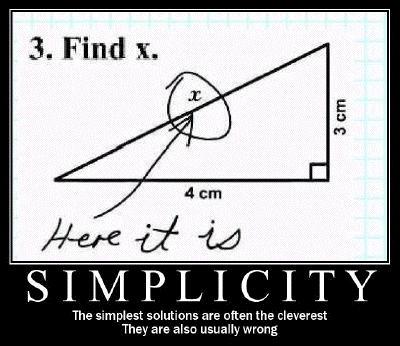
Going back to vertical listening, one must organize their mind to focus on one rhythm. The more we tried to concentrate on one particular rhythm, our minds began to slowly recognize the differences and sort it out. It gets the our mind to dig deeper within the confines of our thoughts, educating ourselves to listen to concealed rhythms. Hence, organization is a vital key point in galvanizing the minds capabilities to expand ideas, in a more simplistic manner. Simplicity is good :)

Image's origin -  http://ozguru.mu.nu/Photos/simplicity.gif