Sunday, September 26, 2010

Metacognition: MindBook

Take a moment to think about your mind. Now, lets break it down. Everyday, the mind creates unlimited, inevitable ideas that enters ones head, regardless of whether the person wants to think of it or not. Our mind is an extraordinary thing, radical beyond our wildest beliefs. When I try to think about the mind, I honestly get headaches due to its complexity and structure. Thus I don't bother at all. However, what I can do is write and draw the ideas and images that do comes out of it. When I gaze at the MindBook, I think of the blank, crisp pages that are limited to only 200 pages. Frankly, that's way less than my mind, or anyone else, can develop thoughts. But when I do begin to mark a page with my 0.5 lead pencil, I feel as if I am teaching a child. So immaculate, so much to tell. In this case, so much to write and draw.

Ideas are born in my mind every second of every day, yet some die before they even get to mature. Some times, my ideas just vanish into the blue without warning, without even expanding it into thoughts. Many times when I over analyze my ideas, they tend to disappear into the recycle bin and deletes itself from within the confines of my own mind. It can get frustrating, but the goal for me is to get whatever I can down on that blank sheet of paper and to write an ID while I'm at it. When I do get the chance to jot down my ideas, I become surprised I even did.

One of the few things I like about my mind is that when I do grab a hold of an idea, I am able to connect it, expand it, jot it, question it, and etc. Of course anyone has the capability to do so, but I come to the point where I don't stop thinking about it. It feeds my mind and allows it to turn in sync with the earth. I start off with a simplistic idea and then, concepts start to roll in along with applications as well. This is the constant basis that my mind runs by, an infinite loop where more new ideas are born and then I try to catch them.

I truly believe it'd be better if I can observe other people's mind and the pattern in how they function. This way, I can try to think in different ways, different perspectives. All this meaning to practice different methods of thinking, however if put into terms thinking is very, very vague. Of course no one can explain how they think, but sometimes I want to jump into others' minds to see how different they are. Coming to realization, why not take a peek into other people's MindBooks to see their thinking? We can probably apply this to other things as well such as essays, how others drive, and do homework as well. Hence, the best the best we can do for now is to observe the work of other people to at least get an idea of how their mind functions. After all, you have to be Wiggins to completely and to the utmost comprehend her novel. Even if we do think we understand fully her novel, we might leave a few things out that her mind uniquely generated and molded. No two minds think alike, and so some things may always remain a mystery.

And so, every time before I start a MindBook entry, my ideas digress and it leads into newer ideas. Henceforth, this is how my mind functions. Everyones creativity is just like their fingerprint, its unique and no one can steal it. We can only decipher so much.


Image's origin - http://mitocw.udsm.ac.tz/NR/rdonlyres/Linguistics-and-Philosophy/24-09Spring-2007/E7224649-7BED-4204-BA14-A2D322D7A7E9/0/chp_blue_head.jpg

Sunday, September 19, 2010

Best of Week: College Essays

Every year, since the beginning of time, the college admissions board read tens of thousands of essays to determine admissions into their schools. Of course, the goal is to make your essay stand out, to impress the person who will eventually read it. However, the process of writing a college essay is quite difficult, regardless of how many ideas you have for it. From personal experience, perfecting a college essay is quite nerve-racking. You're going to ask yourself various questions such as, how should I start it? or what else can I include in it to make it better? However, when we discussed this topic in class, I became much more alleviated with the idea of writing one. Guaranteeing that we'll all walk out "a pro" at these essays instilled in me some level of confidence.

One key part in writing these essays is to break the ideas down into little pieces. While skimming through the "How To Write A College Essay" page in class, I found some interesting techniques that I would not have considered before. One of which is taking baby steps to avoid pressuring yourself. This way, it increases the level of simplicity to allow yourself to think simplistically as well. I came to realize that it's only stressful if you make it stressful. Other techniques on the page talks about correcting your essay, as if it was just any assigned essay from class. Overall, I've realized how much better it made me feel when I actually read the College Essay techniques in class. It allowed me to realize one of the most nerve-racking things can use one of the easiest techniques. This is often a common misconception for most seniors as well.

Although this essay is vital, for it determines your acceptance and most importantly your future, there's no need to stress yourself too much if you know what techniques to utilize.

Image's origin - http://www.papermasters.com/images/Family-Guy-Brian-Back-To-College.gif

Wednesday, September 15, 2010

Connection: Visionary vs. Televisionary

Once upon a time, there was a time in history where the television was an enormous box with black and white images that were transmitted as fuzz. This was at a time in history where the television was nothing more than a luxury rather than a necessity. There was another period in time where the Intermittent wiper setting on an automobile was a radical new idea. Both inventors and engineers, Philo Farnsworth and Robert Kearns, brought their quirky new age inventions to life. However both struggled to avoid contact with major corporations, who at an attempt "stole" their creativity and claimed it theirs, thus causing both Farnsworth and Kearns to retaliate.

Inspiration

Philo Farnsworth was the first person to bring the television to life. Growing up as a farm boy, his inspiration for developing the television was his realization that the parallel lines on the field he had plowed on, transmitted an image on the other side. In this manner, scanning a series of lines as one whole image produced from the back-and-forth motion used to plow a field. From this moment, he had a vision, a vision that a picture could be sent electronically via airwaves. At an instance, he began to study formulas and equations to determine his ideas scientifically to perfect his vision. After dropping out of college, he entered the real world where he encountered his nemeses, David Sarnoff  and Vladimir Zworykin of the RCA Corporation.

Robert Kearns, on the other hand, was the first person to introduce the Intermittent wiper setting in today's modern day vehicles. His idea came to life during his wedding, when a champagne cork flew into his left eye, nearly blinding his left eye permanently. Years later when Kearns was driving in rain, he realized the one and only continuous movement of the wiper blades was adding difficulty to his already impaired vision. This was when a flash of genius kicked in and used the human eye to galvanize his idea. He noticed the human eye blinked ever so often, and applied this to his wiper idea. He stressed the fact that there was always a wiper blade that restricted your field of vision and the screeching due to the friction on dry glass. At this point, he brought his imagination to life and faced the toughest challenge through an encounter with the Ford Motor Company.

Saving Their Inspiration

Farnsworth, who envisioned the transmission of images by gazing at a potato field and Kearns, who nearly turned blind after a champagne cork flew into his eye, are both similar through the brutality they had to run across to "the point of emotional and physical exhaustion," as quoted from Gladwell's article The Televisionary. Neither of them would let their imagination and creativity go to waste to some industrial fat-cats, hence their battle continues on.

Both the RCA Corporation and the Ford Motor Company constantly tried to snatch the imagination of these new age thinkers, who similarly fought for the same case. Although both Farnsworth and Kearns had patented their inventions before, the major corporations, nevertheless, closely observed or rather "stole" their ideas. If the corporations couldn't have Farnsworth nor Kearns, noone could. In both cases, the major corporations proved their actions as viable for they had what both Farnsworth and Kearns didn't have, power and money. This only shows how loosely our society is based off the idea of superiority, and the minority will fall behind. However, Farnsworth and Kearns both conveyed an important key stance by taking these major corporations to court. The risks were high and the chances of winning was grim, yet they persevered to preserve something they had produced and wanted the world to know.

The Legacy 

At an attempt to disprove the theory of superiority, both inventors turned the tables on these major corporations. Farnsworth did so by allowing his invention to be acknowledged with royalty and a pay of one million dollars for his patents. Kearns, on the other hand, successfully sued the Ford Motor Company, and later other motor industries for millions of dollars.

Through their crusades, they took risks and paid the prices, although in the end they were most successful. Both Farnsworth and Kearns in their times sued the major corporation that not only infringed onto their patents but their visions as well. It comes to the point where it is to be said that an idea without a patent nor a vision cannot be achieved successfully. In our society, an idea without a clear indication of ones initials are to be found invalid, for anyone at anytime can steal something you've produced and the worst price to pay is the disappointment. To this day, both these imaginative men got what they deserved, disproving that money and power isn't everything. However, they disproved more than that. They made something that seemed impossible possible by envisioning possibility.

After all, didn't other inventors think the same way? Alexander Bell reinvented communication by coining the telephone. Thomas Edison kissed the candle good-bye with the copious research he put into creating the light bulb. To conclude, most, if not all, inventors leave the same legacy, rethinking possible.

Image's origin - http://gladyssantiago.files.wordpress.com/2010/04/att-rethink-possible.jpg

Thursday, September 9, 2010

What If?: Vertical Listening

I took a moment to reminisce about the vivid conversations we've had in class. One in particular that resonated through my mind was "Vertical Listening." When one looks at a painting and skims through the details, it can be considered a glance. When one stabilizes their minds upon the details of the painting itself, perceptions change and ideas enter ones thoughts. It can be considered the same way for music or taking advantage of your senses to observe the little things that can't always be seen.

Music is the art of sound, and when closely observing it, one is able to envision the beauty found inside every note, accommodations, melody, beat, etc. In class, we closely observed the different beats and tried to focus on one. When the beats and rhythms became more rampant, the level of difficulty increased; to a point where we had to close our eyes and concentrate on one rhythm that was being played. This can relate to life as well, when you try to simplify your worries into one. Having responsibilities such as finishing homework, getting home on time, meeting up with friends gets your mind running in circles. When one organizes their planning, it can not only simplify your mind but part of ones life as well.

Going back to vertical listening, one must organize their mind to focus on one rhythm. The more we tried to concentrate on one particular rhythm, our minds began to slowly recognize the differences and sort it out. It gets the our mind to dig deeper within the confines of our thoughts, educating ourselves to listen to concealed rhythms. Hence, organization is a vital key point in galvanizing the minds capabilities to expand ideas, in a more simplistic manner. Simplicity is good :)

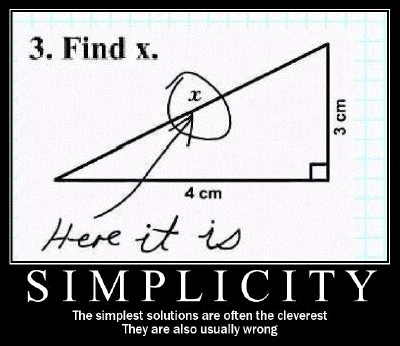
Image's origin -  http://ozguru.mu.nu/Photos/simplicity.gif