Please take the time to consider the following headlines of various newspapers:
Newsweek: "Got Him!"
The New York Times: "Bin Laden Killed By U.S. Forces In Pakistan"
China Star: "乌萨马本拉丹是死"
The Boston Globe: "Bin Laden Is Dead"
The Examiner: "The Butcher of 9/11 Is DEAD"
Daily News: "Rot In Hell!"
The Sun: "Osama Bin Laden Dead"
The death of Osama Bin Laden has caused a huge phenomena across the world, and especially here in the United States. As The Examiner's headline recalls that Bin Laden is "The Butcher of 9/11," his death has symbolized a sense of security to the nation, allowing ourselves to retain to a certain degree of leisure.
Bin Laden has been and is still being referred to such titles as terrorist, hellacious, a heathen, and much worse, so worse I cannot censor the words even with symbols due to the vulgar profanity. This man has symbolized fear in our country, just as the idea of communism had once ran rampant in our minds as "The Red Scare." The media has influenced our opinions and alterations of ideas because one broad casted news cast is indeed a very powerful tool to utilize in order to spread a message. If we recall the Egyptian retaliation or the people's attempt to overthrow Mubarek months ago, the Egyptians were hopeless beyond communicating in person because the government had shut down all types of communication to restrict access to one another.
That speaks a lot, for it seems technology has come to have evolved with us. Without access to the internet and telecommunication, it may very well restrict our ways of communicating, a necessity in today's day and age. Our standards of technology has changed so dramatically, Egypt had suffered difficulties, or restrictions throughout the strike.
Of course, we are heavily dependent on technology and the media, at least the majority of us are. However, is it really our prerogative to follow along with whatever the media says? Well no one else is going to bother competing with major news stations because they are all competing within their corporate system. The truth does matter, however sometimes the media is able to give false information about something for they can get away with it because they'll know most of us are going to believe it anyways. What I'm saying is that it seems we must somewhat give ourselves up to what the news has to say. Well how can that be justified? How do we know certain things are true and untrue?
It's scary how the media is able to do this. Citizen Kane epitomizes this stance for Charles Foster Kane ruled the newspaper business and people allowed themselves to sink into this information, regardless of truth or fiction. Even the Nixon v. Kennedy debate, the first debate to be broad casted on national television was heavily dependent on who was the better speaker. Today, anchorman and woman and reporters, actors, actresses, and many others have mastered their appearance on television. It is quite difficult to see through the truth when they talk as if they were a natural. Our focus on mess-ups and cock-ups on live television has created a new focus on things. Go on YouTube and there are hundreds, if not millions of views on people messing up on live television. This is where our focus is going to!
Here are two examples:
1) http://www.youtube.com/watch?v=trf6Y_5brsk&feature=related
2) http://www.youtube.com/watch?v=PY9IC7njYYc
So what the hell does this have to do with Mr. Osama Bin Laden? Some say it's a conspiracy that the government announced his death to appease the nation. I am not at all advocating this but some evidence are clear and reasonable to actually be found true or likely. I felt like Osama Bin Laden was a huge focus projected through the media, and even if it weren't, it'd still be a big deal. I felt like I had to exemplify his infamy to prove a point, one that isn't too clear. Hence, I am just trying to explain how the media influences our culture and many other things that contribute to our modern day society.
Monday, May 16, 2011

Thursday, May 5, 2011
Blogging Around
Matthew Shancer
Best of Week: Restaurant Sustainability
Matt shares some of his interest in Addie Lord's presentation on a man who owns a series of restaurants and found the food industry to be the most wasteful, and it galvanized him to think in a certain way, to help reduce waste, at least his own. Time, space, effort and waste. These are the four vital wastes that Matt mentions, and the ones he wonders about to make things better.
Comment - Matt, when I read this, I thought it was interesting too. I wasn't there for Addie's presentation, but I can surely agree with the fact that the four waste factors, Time, space, effort, and of course waste are all very wasteful, for it can relate to me, or anybody in that case. It made me think a little, then I also wondered if I could start improving the things around me by applying these four things and keeping em' in mind.
Julie Lee
Best of Week: Water Shortage
With only 2.97% of fresh water inaccessible, people don't realize how limited we are, as Julie says in her blog posting. She refers to Marina Nikolic's TED Presentation, where she talks about the scarcity of fresh water and her experience in Serbia. Julie also shares how she, like many other ad myself, exploit the use of fresh water as well.
Comment - I think it's interesting how you learned about water conservation in AP Environmental. It is true how we exploit the use of fresh water, even though there is very little of it. If we consider how much water we use in a day, the numbers can be catastrophic in reference to how many people brush their teeth with the water running and how many people make copious flushes after utilizing the toilet. In essence, I do the same, and it's all in the habit. I can only wonder if we all put in the effort to alter our habits, how much water can be saved. This posting really got me thinking.
Best of Week: Restaurant Sustainability
Matt shares some of his interest in Addie Lord's presentation on a man who owns a series of restaurants and found the food industry to be the most wasteful, and it galvanized him to think in a certain way, to help reduce waste, at least his own. Time, space, effort and waste. These are the four vital wastes that Matt mentions, and the ones he wonders about to make things better.
Comment - Matt, when I read this, I thought it was interesting too. I wasn't there for Addie's presentation, but I can surely agree with the fact that the four waste factors, Time, space, effort, and of course waste are all very wasteful, for it can relate to me, or anybody in that case. It made me think a little, then I also wondered if I could start improving the things around me by applying these four things and keeping em' in mind.
Julie Lee
Best of Week: Water Shortage
With only 2.97% of fresh water inaccessible, people don't realize how limited we are, as Julie says in her blog posting. She refers to Marina Nikolic's TED Presentation, where she talks about the scarcity of fresh water and her experience in Serbia. Julie also shares how she, like many other ad myself, exploit the use of fresh water as well.
Comment - I think it's interesting how you learned about water conservation in AP Environmental. It is true how we exploit the use of fresh water, even though there is very little of it. If we consider how much water we use in a day, the numbers can be catastrophic in reference to how many people brush their teeth with the water running and how many people make copious flushes after utilizing the toilet. In essence, I do the same, and it's all in the habit. I can only wonder if we all put in the effort to alter our habits, how much water can be saved. This posting really got me thinking.
Sunday, May 1, 2011
Best of Week: Consilience
This week, we concluded the first half of the "Consilience" essay by Sir. E.O. Wilson. To be honest, I had no idea where this essay was going, due to the wording, terms, and his various outside sources. As I read this essay, I had a tendency to think too hard and digress from what I was thinking. I had no idea what "Consilience," interpretation, or what the title of his essay meant.
Reading it a second time with a dictionary in hand, it seemed a bit easier to comprehend his vast word choice. It made sense that how we as humans have evolved in such a way. When we discussed the essay in class, it made more sense, for what he was trying to say was that art and genetics come together. Wilson sees postmodernism as a "deconstructive philosophy," while stating art comes from human nature for there is a point where it all connects together, referring to the connecting the dots idea from class. His ideas carry out to be a thorough explanation of his interpretation of how humans and art come together. This made me think, doesn't art come from humans? Didn't we interpret this idea? As we went more in-depth - into the essay, his explanation of the Picasso effect and claiming creativity made some logical sense, seeing ourselves all around us. I began to think of how brilliant this essay was, as he over-exaggerates interpretation.
So I got the big picture, great, but did I really understand every detail of his essay? Not really. I don't think I can unless I study it day and night. But the thing is that, I understand what he's saying. I was able to connect the dots and decipher his idea, raveled up in his mischievous vocabulary. He says that "the arts are eternally discursive," and I can relate to that because it's always changing. If there's modernism and post-modernism, there'll hopefully be a neo-modernism or something like that, exerting another idea of the arts, a different perspective. Although I sort of disliked "Consilience" at first, I can really connect to what he says, as if I can have a conversation with Wilson over a cup of coffee. This is why Wilson's essay is my Best of Week.
Wilson, Edward O. "Chapter 10 - The Arts and Their Interpretation." Consilience: the Unity of Knowledge. New York: Knopf, 1998. 230-59. Print.
Reading it a second time with a dictionary in hand, it seemed a bit easier to comprehend his vast word choice. It made sense that how we as humans have evolved in such a way. When we discussed the essay in class, it made more sense, for what he was trying to say was that art and genetics come together. Wilson sees postmodernism as a "deconstructive philosophy," while stating art comes from human nature for there is a point where it all connects together, referring to the connecting the dots idea from class. His ideas carry out to be a thorough explanation of his interpretation of how humans and art come together. This made me think, doesn't art come from humans? Didn't we interpret this idea? As we went more in-depth - into the essay, his explanation of the Picasso effect and claiming creativity made some logical sense, seeing ourselves all around us. I began to think of how brilliant this essay was, as he over-exaggerates interpretation.
So I got the big picture, great, but did I really understand every detail of his essay? Not really. I don't think I can unless I study it day and night. But the thing is that, I understand what he's saying. I was able to connect the dots and decipher his idea, raveled up in his mischievous vocabulary. He says that "the arts are eternally discursive," and I can relate to that because it's always changing. If there's modernism and post-modernism, there'll hopefully be a neo-modernism or something like that, exerting another idea of the arts, a different perspective. Although I sort of disliked "Consilience" at first, I can really connect to what he says, as if I can have a conversation with Wilson over a cup of coffee. This is why Wilson's essay is my Best of Week.
Wilson, Edward O. "Chapter 10 - The Arts and Their Interpretation." Consilience: the Unity of Knowledge. New York: Knopf, 1998. 230-59. Print.
Sunday, April 24, 2011
Best of Week: Do You Mind??!!
"Do You Mind??!!" the daily two question activity we all enjoy so much. Whether you choose to answer these questions seriously, jokingly, or whatever way you want to perceive them, it gets our minds to go father within its own thinking space, all within two minutes at a time. What I mean by is that it allows us to use our mind in such a way...that we would never had bothered thinking about or answering these questions if it weren't for bring enrolled into Humanities, Mr. J.E. Allen's humanities class of course. It makes me think about the questions at first hand and what it'd be like if I never came across these questions.
Some may say they're redundant, some may say they're amusing, to me it's a good chance to experiment with my mind and see what I've been holding back on. It's because, who the hell wakes up every morning with questions like this and takes the time to ponder upon these ambiguous, yet thoughtful questions? The way I see it, the answers are beyond infinite, and they can all be answered in different ways depending on how you perceive it.
Of course, the "Do You Mind??!!" activity isn't the only thing that has infinite answers to it, it's just one of those things that do. I am quite happy I did come across meeting Mr. Allen and following along with this activity because I enjoy thinking about something random, clever, childish, anything, to answer these questions.
I believe this activity's purpose is to help us enhance, explore, develop a more creative mind, for I feel as if it is carving our minds, molding it to make it exert better things. And whatever these better things are, I feel as if it clarifies my ideas a bit. Of course others might not think the same or feel as if their minds are being clarified, refreshed or whatever, I certainly think this was worthy of mentioning in my Best of Week blog posting.
Perhaps this can change the way I think, even if it is just a little activity that takes only four minutes of the sixteen hours we're awake. Even the smallest things can make quite a big change, for this activity allows one to find a greater meaning within their own mind, to explore, find, possibly recreate, and of course utilize. Thus, this challenges the status quo - our daily basis - and makes it a part of it.
And so "Do I Mind??!!" being asked these questions? Not at all.
Some may say they're redundant, some may say they're amusing, to me it's a good chance to experiment with my mind and see what I've been holding back on. It's because, who the hell wakes up every morning with questions like this and takes the time to ponder upon these ambiguous, yet thoughtful questions? The way I see it, the answers are beyond infinite, and they can all be answered in different ways depending on how you perceive it.
Of course, the "Do You Mind??!!" activity isn't the only thing that has infinite answers to it, it's just one of those things that do. I am quite happy I did come across meeting Mr. Allen and following along with this activity because I enjoy thinking about something random, clever, childish, anything, to answer these questions.
I believe this activity's purpose is to help us enhance, explore, develop a more creative mind, for I feel as if it is carving our minds, molding it to make it exert better things. And whatever these better things are, I feel as if it clarifies my ideas a bit. Of course others might not think the same or feel as if their minds are being clarified, refreshed or whatever, I certainly think this was worthy of mentioning in my Best of Week blog posting.
Perhaps this can change the way I think, even if it is just a little activity that takes only four minutes of the sixteen hours we're awake. Even the smallest things can make quite a big change, for this activity allows one to find a greater meaning within their own mind, to explore, find, possibly recreate, and of course utilize. Thus, this challenges the status quo - our daily basis - and makes it a part of it.
And so "Do I Mind??!!" being asked these questions? Not at all.
Friday, April 22, 2011
Blogging Around
Joseph Gaydaychuk
Captured thought: Making videos go viral to spread information
Joseph takes a different approach on viewing Rebecca Black's "Friday" video. He talks about using the video's popularity to promote a cause or an advertisement.I truly believe this can be a good idea.
Comment - Joseph, your philosophies never seizes to amuse me. I agree with your approach to utilize something viral to alter its image, in an effort to use it against...well quintessentially CHALLENGING THE STATUS QUO basically. Mind you, that is also an ADJACENT POSSIBLE. Looking at Japan, maybe Rebecca Balck's video can be put to some good use. Good idea mate. Cheers!
Kathryn Johanson
Captured Thought: People discriminate against teenagers in stores
Kathryn talks about how some stores profile their customers through age, discriminating their younger customers thinking they are impecunious. Of course we are talking about the store "that attract teens are those that have reasonable prices and have good customer service." She believes this is unjust and cruel, being fortunate of the stores that have good prices and good customer service.
Comment - Kathryn, I know where you are going with this, some store make it their prerogative to think their younger buyers, if they even classify us as buyers, have nothing more than lint in our pockets. I may be exaggerating, but I know this is true if you go to a store that carries more expensive products. I guess it's because they'd think we'd only window shop. But as we see time run into the future, I guess this will be resolved if noticed to a greater extent. It worked for woman's voting rights, why not this?
Tuesday, March 15, 2011
Final Blog for Literature Circle
For Literature Circle, I read The Post-American World by Fareed Zakaria. I will be responding to Marina Nikolic's book, The Immortal Life of Henrietta Lacks by Rebecca Skloot, to whom I was paired with in the Liturature Circle discussion group on the 3rd meeting.
Whereas The Post-American World talks about the current status of nations that are up against the U.S., The Immortal Life of Henrietta Lacks tells a story of how Henrietta Lacks, supposedly an African-American woman who had her cells stolen by white doctors, during a cervical cancer operation. When our groups met up to discuss the key ideas of both our books, we found there were very little to nil information we could connect to each others' book. However with the very little information, our group found a connection, which involved challenging the status quo.
In The Post-American World, author Fareed Zakaria talks about and focuses on the "rise of everyone else". A lot of what Zakaria talks about focuses on how the world is advancing; countries utilizing ideas and influences to increase a country's status for the better. Some of the key players that are up against the U.S. are China, Japan, India, France, Germany, and many more. Again, Zakaria mentions how the U.S.'s stance is still higher than that of other nations, which makes the U.S. still a superpower. He talks about how if America does not continue to improve its status, then other rising nations will soon snag the throne of being the international superpower, an interesting yet fearful thing to think about. According to Zakaria, "Ever since the collapse of the U.S.S.R., the U.S. has walked the world like a colossus, unrivaled and unchecked. This had its benefits, but it made Washington arrogant, careless, and lazy" (Zakaria, 219). Just as we discussed in our group, some American's being patriotic and all, doesn't want to admit the fact that the U.S. is slowly coming to a decline. The truth is, what's happening in today's world - the rise of other countries - challenges the status quo because of the fact that some Americans are just too used to what they think of what things used to be, which to them still applies today.
The status quo is also challenged in The Immortal Life of Henrietta Lacks, given the fact that doctors stole her cells for their own benefits, which changed Henrietta Lacks life forever. As Marina talks about in her blog post, this event made such an impact to Skloot (the author), it got her to write the book and her finding information on the whereabouts of Lacks to write her book. Sadly, Lack's unfortunate experience brought us to have new medical findings; at the same time challenging the status quo, yet showing sign of an adjacent possible.
Through the connections made, I can conclude by saying that challenging the status quo brought, or shows hints of changing the things around us all together.
Zakaria, Fareed. The Post-American World. New York: W.W. Norton & Company, 2009. 219. Print.
Whereas The Post-American World talks about the current status of nations that are up against the U.S., The Immortal Life of Henrietta Lacks tells a story of how Henrietta Lacks, supposedly an African-American woman who had her cells stolen by white doctors, during a cervical cancer operation. When our groups met up to discuss the key ideas of both our books, we found there were very little to nil information we could connect to each others' book. However with the very little information, our group found a connection, which involved challenging the status quo.
In The Post-American World, author Fareed Zakaria talks about and focuses on the "rise of everyone else". A lot of what Zakaria talks about focuses on how the world is advancing; countries utilizing ideas and influences to increase a country's status for the better. Some of the key players that are up against the U.S. are China, Japan, India, France, Germany, and many more. Again, Zakaria mentions how the U.S.'s stance is still higher than that of other nations, which makes the U.S. still a superpower. He talks about how if America does not continue to improve its status, then other rising nations will soon snag the throne of being the international superpower, an interesting yet fearful thing to think about. According to Zakaria, "Ever since the collapse of the U.S.S.R., the U.S. has walked the world like a colossus, unrivaled and unchecked. This had its benefits, but it made Washington arrogant, careless, and lazy" (Zakaria, 219). Just as we discussed in our group, some American's being patriotic and all, doesn't want to admit the fact that the U.S. is slowly coming to a decline. The truth is, what's happening in today's world - the rise of other countries - challenges the status quo because of the fact that some Americans are just too used to what they think of what things used to be, which to them still applies today.
The status quo is also challenged in The Immortal Life of Henrietta Lacks, given the fact that doctors stole her cells for their own benefits, which changed Henrietta Lacks life forever. As Marina talks about in her blog post, this event made such an impact to Skloot (the author), it got her to write the book and her finding information on the whereabouts of Lacks to write her book. Sadly, Lack's unfortunate experience brought us to have new medical findings; at the same time challenging the status quo, yet showing sign of an adjacent possible.
Through the connections made, I can conclude by saying that challenging the status quo brought, or shows hints of changing the things around us all together.
Zakaria, Fareed. The Post-American World. New York: W.W. Norton & Company, 2009. 219. Print.
 | |
| Image's origin - http://www.nicholashind.com/wp-content/uploads/2010/11/changes.jpg |
Wednesday, March 9, 2011
Captured Thought: Visualizing Millions of Thoughts All At Once
There's the old saying that a picture has a million stories alone. Sadly, some cannot capture the arrow in the FedEx logo or see through optical allusions. The thing is, even the most simplest things can have a profound meaning, with endless possibilities. So now if you're wondering what "Now I got it!" moment I've captured in my head, let me introduce you to Mr. E.E. Cummings.
In class, reading Mr. Cummings poems seemed redundant and meaningless, so meaningless in fact I literally wanted to tear my packet of poems and feed them to live eels! Going past the philistine moment I've had, Mr. Allen opened one of my eyes to allow the myself and the class to envision something greater, yet complex. When we were going through the "1(a...(a leaf falls on loneliness)" poem, he talked about how when the poem is written vertically, as he claimed Mr. Cummings insisted on doing, he talks about how the poem was formed, in accordance to the shape with words and symbols. Apparently the falling leaf falls according to the smooth curvature of the words and symbols. Then I opened both my eyes to welcome the limitless ideas that stormed into my brain, happily envisioning what E.E. Cummings could've thought of writing the poem. I envisioned a tree with an empty spot, showing that the leaf fell out. I also saw the meaning in accordance to the words, loneliness; like having a leaf fall inside you.
So that concludes my "Now I got it!" moment. I started off mad, if not furious and with a despise consisting of great intensity. I realized what vertical listening was from last semester, an adjacent possible for this activity we've conducted in class. It's like playing a guitar, you never know what tone, rhythm, or chaos you're gonna orchestrate once you start composing and playing.
In class, reading Mr. Cummings poems seemed redundant and meaningless, so meaningless in fact I literally wanted to tear my packet of poems and feed them to live eels! Going past the philistine moment I've had, Mr. Allen opened one of my eyes to allow the myself and the class to envision something greater, yet complex. When we were going through the "1(a...(a leaf falls on loneliness)" poem, he talked about how when the poem is written vertically, as he claimed Mr. Cummings insisted on doing, he talks about how the poem was formed, in accordance to the shape with words and symbols. Apparently the falling leaf falls according to the smooth curvature of the words and symbols. Then I opened both my eyes to welcome the limitless ideas that stormed into my brain, happily envisioning what E.E. Cummings could've thought of writing the poem. I envisioned a tree with an empty spot, showing that the leaf fell out. I also saw the meaning in accordance to the words, loneliness; like having a leaf fall inside you.
So that concludes my "Now I got it!" moment. I started off mad, if not furious and with a despise consisting of great intensity. I realized what vertical listening was from last semester, an adjacent possible for this activity we've conducted in class. It's like playing a guitar, you never know what tone, rhythm, or chaos you're gonna orchestrate once you start composing and playing.
 |
| Image's origin - http://www.recyclethis.co.uk/wp-content/uploads/2009/05/guitar_strings.jpg |
Tuesday, February 1, 2011
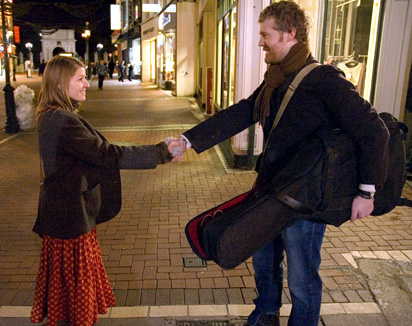
Connection: "Once" upon a time, there was "The Office"
As I walked half awake into Humanities with nothing more than an essay and an urge to fall asleep, I sat down with my head down only to figure out our class was watching a movie. When the projector started formulating orchestrated colors to induce movement in colors, my mind slowly awakened from its struggle to operate due to the severe lack of sleep. As the movie progressed, I was surprised that the events in the film were sort of unorthodox and worth a laugh. I found Once to be an interesting movie for it does something so un-cliche, something ambitious that to mock the conventional, systematic plot used by the Hollywood film industry. It indeed challenges the status quo. How and why? Because the film is a mere representation of reality, which lets the plot loosely flow as if we the viewers were just observing the lives of the characters.
Here's an example of what I'm talking about. In a conventional Hollywood romance film, the guy and the girl always come together to live a happy life, so on and so forth. Now, it is quite evident that Once, to a certain degree, challenges the status quo. The film was a delight to watch and profoundly different, through their near-realistic plot, camera angles/movements (as discussed in class), and many other techniques. All these aspects or techniques aid the viewers in perceiving that this film is realistic. The film tries to play with originality by taking moments in the movie where the audience is believed to think that the same cliche, Hollywood storyline would jump in and dictate the ending. The director deliberately ruins the corny Hollywood scene where the guy kisses the girl and they both live happily ever after to put the viewer back in their place, playing with their expectations. What the director also tries to do is challenge the status quo by putting this different storyline to convey a message; not all films have to be the same and flow into a happy ending, controlling the plot in order to do so. I truly believe it was a relief to watch a movie that focuses on making something as realistic as possible, rather than throwing some realistic aspects and making the ending predictable, as always.
NBC's comedy television series The Office does something rather similar to keep the feeling that the show is being filmed in front of our own eyes. The director does so by making the viewer think the characters are talking directly at the viewer. Another thing is that both Once and the Office focus on plots that are un-cliche and unpredictable, which makes it more real, no? The endings always feel like there needs to more to it, rather half-assed, and that's what makes it real! I'm not a person to watch a movie where the storyline is un-cliche and where the director totally messes up the plot, but I see it as a good thing. I can't watch cliche movies for the rest of my life. I see this as a way to enhance one's perspective, to transcend the conventional cliche plots we're so used to.
And so in accordance to the title of this article, not all things may live "happily ever after."
...and that's the saddening truth of reality.
Here's an example of what I'm talking about. In a conventional Hollywood romance film, the guy and the girl always come together to live a happy life, so on and so forth. Now, it is quite evident that Once, to a certain degree, challenges the status quo. The film was a delight to watch and profoundly different, through their near-realistic plot, camera angles/movements (as discussed in class), and many other techniques. All these aspects or techniques aid the viewers in perceiving that this film is realistic. The film tries to play with originality by taking moments in the movie where the audience is believed to think that the same cliche, Hollywood storyline would jump in and dictate the ending. The director deliberately ruins the corny Hollywood scene where the guy kisses the girl and they both live happily ever after to put the viewer back in their place, playing with their expectations. What the director also tries to do is challenge the status quo by putting this different storyline to convey a message; not all films have to be the same and flow into a happy ending, controlling the plot in order to do so. I truly believe it was a relief to watch a movie that focuses on making something as realistic as possible, rather than throwing some realistic aspects and making the ending predictable, as always.
NBC's comedy television series The Office does something rather similar to keep the feeling that the show is being filmed in front of our own eyes. The director does so by making the viewer think the characters are talking directly at the viewer. Another thing is that both Once and the Office focus on plots that are un-cliche and unpredictable, which makes it more real, no? The endings always feel like there needs to more to it, rather half-assed, and that's what makes it real! I'm not a person to watch a movie where the storyline is un-cliche and where the director totally messes up the plot, but I see it as a good thing. I can't watch cliche movies for the rest of my life. I see this as a way to enhance one's perspective, to transcend the conventional cliche plots we're so used to.
And so in accordance to the title of this article, not all things may live "happily ever after."
...and that's the saddening truth of reality.
 |
| Image's origin - http://www.hollywoodchicago.com/uploaded_images/1-740802.jpg |
Saturday, January 8, 2011
Metacognition: First Semester
Although sentences or words cannot fully explain the understandings that I've established in my head, I've come to realize that I've matured philosophically and found it capable to see things in a broader perspective. In others words I don't look straight ahead to see what's coming like I did before, I look around to make sure all is at equilibrium, or rather something close to it. I check my surroundings to make it safe to carry on and think more carefully of the outcome.
Vertical listening, however, isn't the only application I've made so far. I use it when the sun comes up, varying on whenever it is. I sometimes use it literally because, well I can. Sometimes I use it metaphorically to write poems and I slowly realize that I should edit it more to make the final product better. I use it when I drive so some bloke doesn't come rolling out of their drive-ways. I did use it before but now my awareness has increased drastically. The fact of the matter is, I've gained so much out of the first semester and hopefully my views will change drastically as I did with vertical listening. At the moment, I love vertical listening because you can get so much more out of life, knowing or rather seeing what to look for. It's like high beaming the future without the person in front of you becoming irate.
One example of this idea can be conveyed through the vertical listening activity we've conducted in class. At first, we could control what we heard, however as the rhythm complicated and orchestrated into something far more complex, our minds could not keep up and separate the differences, which was the aim for the activity itself. Considering that Mr. Allen has listened to the classical piece at least a hundred times now through out his Humanities course, he is able to galvanize newer thoughts upon the piece, discovering more every time. At first we all think straight ahead, telling ourselves, "well isn't this an easy one." Unfortunately, no ones super human and we need repetition to hear something new every time we go back to it. I had a tendency to make it a prerogative to think that what I heard or seen my first time to be seen as is. This was five years earlier in 2005 when I could only decipher so much. Then I came to question my perspective on its credibility, just as Locke proposed.
However, the vertical listening gave me a spur of the moment sort of reaction and caught exactly what I was trying to look for since 2005, we must play with our perceptions more. We must play with it more every time so we can catch flaws and discover something others weren't able to see. It's like proof reading a book to check if there's no errors or starring at a FedEx truck to see more than an arrow, which I highly doubt. There's always something more every time one takes the opportunity to go back and observe the possibilities, and that's why to this day humans look at history to make the future better, both abating the percent of mistakes and presenting new ideas from past idea.
Vertical listening, however, isn't the only application I've made so far. I use it when the sun comes up, varying on whenever it is. I sometimes use it literally because, well I can. Sometimes I use it metaphorically to write poems and I slowly realize that I should edit it more to make the final product better. I use it when I drive so some bloke doesn't come rolling out of their drive-ways. I did use it before but now my awareness has increased drastically. The fact of the matter is, I've gained so much out of the first semester and hopefully my views will change drastically as I did with vertical listening. At the moment, I love vertical listening because you can get so much more out of life, knowing or rather seeing what to look for. It's like high beaming the future without the person in front of you becoming irate.
Subscribe to:
Comments (Atom)